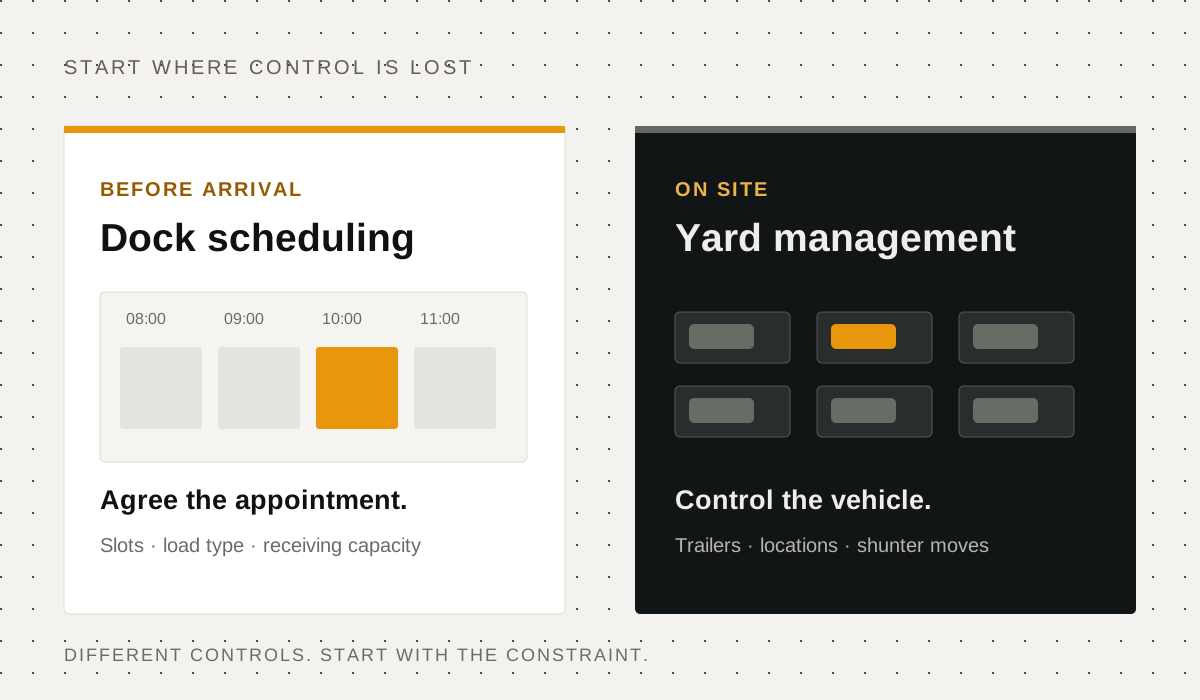
One of the quickest ways to create a queue is to treat every dock door as identical capacity.
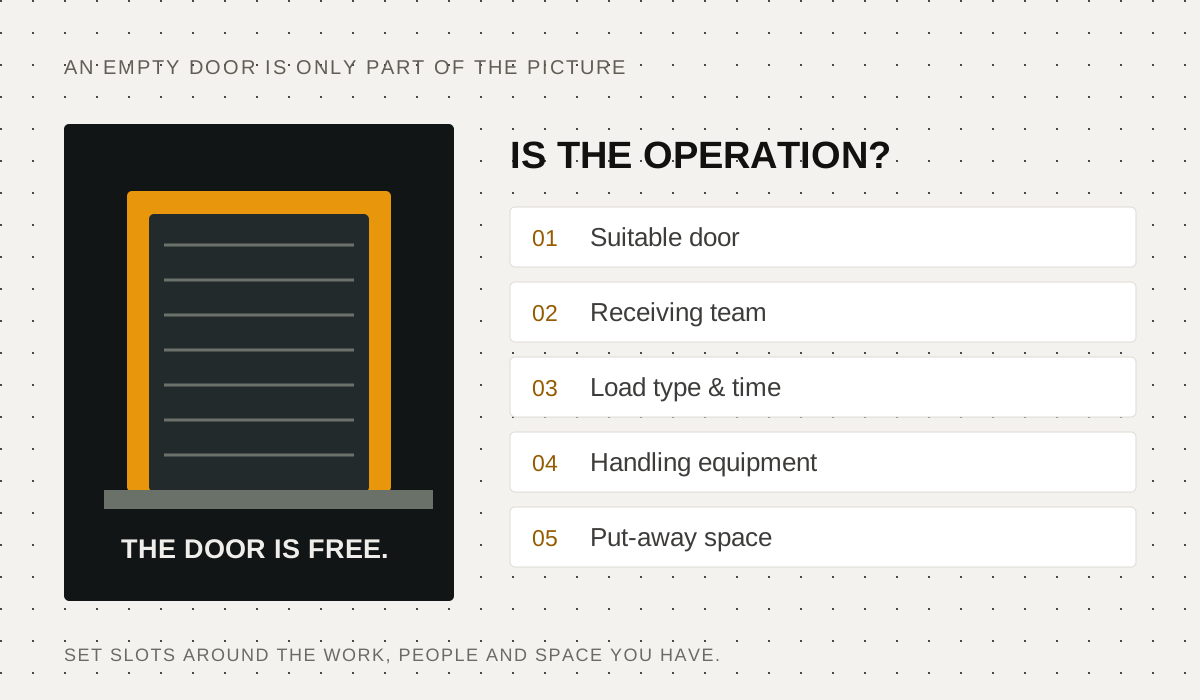
On a scheduling screen, a door may look free at 10.00. On the floor, it may be unusable. The receiving team may be unloading another vehicle. The right forklift may be committed elsewhere. The delivery may be floor-loaded rather than palletised. The marshalling area may be full because put-away is already behind.
The door is empty. The warehouse is not available.
This is a familiar problem in warehouse delivery slot booking. A calendar is set up with equal windows across the day; suppliers book into them; then the operation has to absorb work that was never genuinely possible. The external queue is reduced only by moving it onto the dock or into the goods-in area.
Start with the work, not the doors
Start with the work, not the number of doors. A routine palletised inbound delivery, a floor-loaded container, a returns collection and an outbound collection do not demand the same handling time or resources. Group the activity into a few recognisable types, then give each one a sensible booking rule. It does not need to be complicated. The important thing is that the rule matches how the site actually runs.
Check what is actually available
Next, look at what changes through the day. Which doors are genuinely available for that type of vehicle? Which people will be present after breaks, handovers and other commitments? Is the required MHE free? Can stock move on once the vehicle is unloaded? And how much time is needed for ordinary variation—a late arrival, paperwork, door turnover or a load that takes longer than expected?
Leave the plan room to recover
That final point is usually neglected. A schedule that uses every theoretical minute has no capacity to recover. The first delay becomes the next delay, then the next one. A modest buffer is not wasted time; it is what allows the plan to remain credible.
Refine the rules using actual appointments
Once the rules are in place, use actual appointment data to refine them. If one type of delivery repeatedly overruns, check the slot length and the downstream process before asking the team to work faster. If a period is consistently quiet, widen availability carefully. This is how dock scheduling becomes an operating control rather than a booking diary.
DockSync lets warehouse teams set delivery slot rules around the capacity they really have: load type, available time and the conditions the floor needs to receive work safely and predictably.